When a dog pulls excessively on leash, it is unpleasant for both the dog and the person walking him. Many people resort to yanking on their dogs, using pinch or choke collars, or stopping every few feet hoping for something to change. Using a choke chain or pinch collar may lessen pulling temporarily, but these collars are very unpleasant for your dog and can be physically damaging. Trying to force your dog to walk behind you can be just as unpleasant. However, there are many fun, motivating, and gentle ways to lessen your dog’s pulling. By following the below tips, your walks will improve with your dog and you will both enjoy walking together.
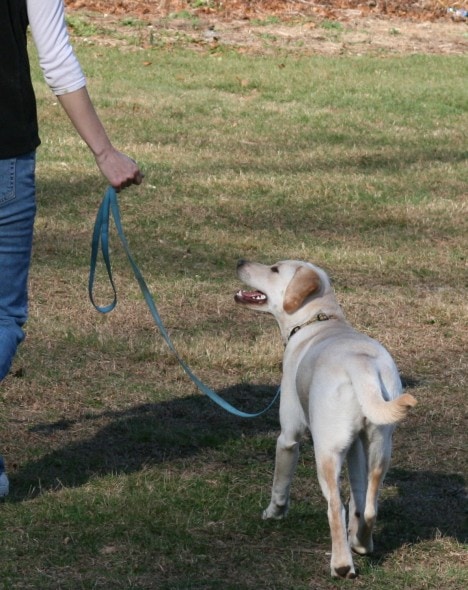 1) Reinforce and reward all attention your dog gives you. When your dog is attentive to you, he will look at you or in your direction. If you cannot get your dog’s attention while out on a walk, you will not be able to communicate with him. Start in a quiet location — indoors is okay. Make a high-pitched noise or sound that has intonation or inflection, such as a perky “Hey,” or make a clicking noise with your tongue (most dogs respond well to this). The moment your dog looks at you in response, pop an extra delicious treat in his mouth. Repeat this exercise until your dog quickly looks at you when he hears your cue. When taking the attention exercise outside, practice at times when it is relatively quiet and in locations that are not too busy or distracting.
You can also shape attention by simply praising and treating your dog every time he looks at you or glances in your direction while on a walk. Your dog will look at you and check in with you more frequently. If your dog obsesses over you, looking for food, ignore him for a little while. Wait until he stops focusing on you or he looks at something else and becomes mildly distracted. Make the fun attention noise you’ve been shaping. The moment your dog looks at you, praise him and give him a mouth-watering treat. Your dog will begin to look at you when there are distractions outside. Keep rewarding your dog until he checks in with you regularly. Your dog will naturally start to look at you for guidance and direction.
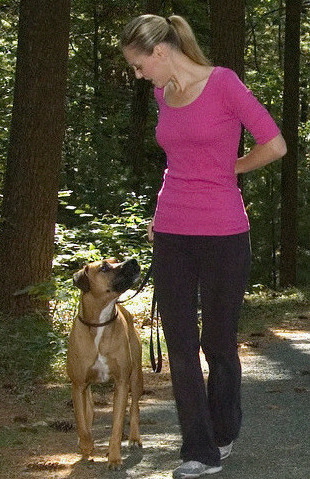 2) Acknowledge and reward your dog for following you without physically forcing or pushing and pulling him to do so. Exaggerate your body language when you walk, turn, and stop. Give your dog positive verbal feedback and reward him for copying you. If you turn, and he turns with you, praise and treat him. When he stops after you do, tell him how great he is. Then cue his behaviors by labeling what you do on walks. For instance, when you stop at a curb, he will too. Tell him to “Wait” as he stands next to you. Then give him a treat. When you start walking again say, “Let’s go.” As you turn or change direction, make a little attention noise before you turn, and say “This way” — you get the idea! Treat him when he turns with you to follow. You are now labeling his behaviors so he can learn to take cues from you.
3) Make walking fun! Your dog’s walk is for his benefit. It is his time to de-stress and enjoy himself. People often are impatient when dogs stop to sniff on walks or when they stop to look at something. They pull or yank their dogs to follow them. Allow your dog to sniff on walks. He will enjoy his walks more and therefore, will be more responsive to you when you give him an instruction or want him to follow you. When your dog stops to look at something, let him. Then say “Let’s go” and praise him for continuing to walk with you.
If you have a dog who likes to chew, take balls or sticks on the walks with you. Let your dog chew or play with the toys, balls, or sticks while you walk together. Your dog will enjoy his walks and your company. He will be much more interested in you, and there will be less disconnect or conflict on the leash.
4) Speed up your walks and vary the pace. Dogs have four legs and a low center of gravity. They walk faster than most people run. Forcing a dog to walk behind you is uncomfortable and extremely unpleasant to him. It sets up a confrontation with your dog when there is no need for one. By quickening the pace of your walk, your dog will pull less and he will get more exercise. If your dog wants to walk quickly, pat your thigh and say “Quickly,” then run with him. Reward him for running with you. Slow down, and then praise and treat him for walking with you again. By allowing him to walk at a more normal pace for him, he will be more relaxed and more attentive to you.
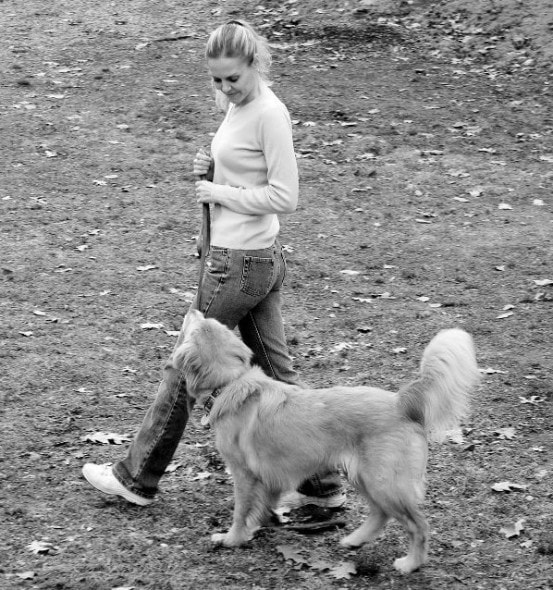 5) Jerk less. Instead of yanking your dog or keeping the leash tight, maintain a relaxed leash. Dogs have an oppositional reflex, which means the more you push or pull against them, the more they will push or pull back in return. This is your dog’s automatic response, regardless of his age or breed. If your dog pulls you or steers you in a direction you do not want him to go in, instead of yanking or pulling back on him, lock your elbow and stiffen your arm, or simply stop for a moment. He will stop what he is doing and slow down or check in with you.
In summary, by praising and rewarding your dog for looking at you, turning with you, and stopping when you do, and by making walks fun and interesting for your dog, he will be more attentive and responsive to you. You’ll both be able to enjoy walks again.
Copyright © Alana Stevenson 2012
Alana Stevenson is the author of Training Your Dog the Humane Way and The Right Way the First Time. She can be contacted through her website AlanaStevenson.com. She provides consultations through phone and Skype.